Sound Judgement: A Repeatable Noise Test Your Club Can Actually Trust
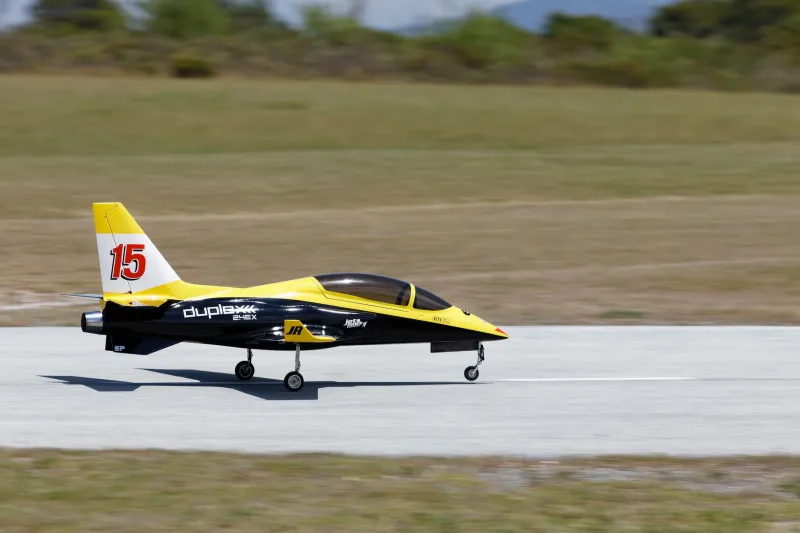
Photo: Jim1138, CC BY-SA 4.0, via Wikimedia Commons
Every club has a version of the same conversation. One member says the model is fine. Another says it is the loudest thing on the patch since the mower died. Both are being honest, and both are probably wrong, because neither of them has a number. Noise is one of the few things at a flying site that we argue about purely from memory, and memory is a terrible measuring instrument.
This is the workshop side of that argument: a repeatable test you can run at the field in ten minutes, log on a single sheet of paper, and hand to a committee or a neighbour without embarrassment. It will not turn a cheap meter into a calibrated laboratory instrument, but it will let you compare your model to itself, to the club's guidance and to the model that everybody agrees is quiet.
Why "it sounded quieter" is not evidence
Human hearing is a poor judge of small changes and a superb judge of large ones. Move two metres further away, turn slightly downwind, wait until the mower has stopped, or test at the end of a long day when your ears are tired, and the same model will seem to gain or lose several decibels. That is before we get to the fact that a change of prop can shift the character of the sound — sharper, harder, more of a crack — without shifting the level at all.
The fix is boring and effective: fix the distance, fix the meter settings, fix the person holding it, and write down what you did.
The kit that earns its place in the flight box
- A sound level meter with A-weighting and a max-hold or fast-response setting. A £30–£50 unit is perfectly adequate for comparison work; a Class 2 meter is nicer if the club is buying one between you.
- An optical tachometer, or a decent acoustic tach app as a fallback. You need RPM, not just a feeling.
- A 10 m tape and a couple of pegs or tent pegs to mark the meter position.
- A clipboard and a printed log sheet — or a note on your phone, as long as you actually fill it in.
A-weighting is the setting that roughly mirrors how the human ear responds, and it is the one used in the guidance most UK clubs quote. Leave it there. Do not spend the afternoon flicking between A and C weighting and then wonder why the numbers will not compare.
Set the stage once, then leave it alone
Pick a patch of open ground with no wall, fence, shed or hedge within ten metres of either the model or the meter. Hard surfaces bounce sound back at you; hedges swallow it; a nearby building can make a quiet model read high and a loud one read oddly low depending on where you stand.
Adopt a fixed geometry and write it down. A sensible club protocol is seven metres from the model, meter at roughly one metre above the ground, model facing away from the meter so the exhaust side is presented to it. That last detail matters more than people think, because the exhaust and the prop tips are not equally noisy in every direction. Whatever you choose, choose it once and use it for every model and every test.
Do not test in a stiff crosswind, and do not test with the meter downwind of the model if you can avoid it. Wind noise on the microphone is the single most common source of nonsense readings.
The run itself
Start the engine and let it warm for half a minute. Then, with the model restrained or held safely by a helper, run three short bursts at full throttle, each about five to ten seconds, and note the highest figure the meter shows. Repeat at three-quarter throttle, half throttle and idle. Three passes at each setting, noting the highest, is enough — more than that and you are just wearing out your starter.
Record the RPM at each throttle setting as well. This is the step almost everybody skips, and it is the one that makes the log useful six months later. A prop change that drops peak RPM by 800 revs will usually drop the noise with it, and without the tach reading you will not know whether the model got quieter or you simply leaned the needle out.
The log is the whole point
A single row per test is all you need: date, model, engine, prop, muffler, ambient conditions, the four throttle readings and the corresponding RPM. Add a line for anything you changed. If the club keeps a folder, keep it there; if not, a shared spreadsheet is fine, as long as it is the same spreadsheet.
That log is what turns a row in the clubhouse into a proper discussion. When someone says the new silencer made no difference, you can point at the two rows and settle it in ten seconds.
Before-and-after testing
Change one thing at a time. If you fit a new muffler and a different prop on the same afternoon, you have learned nothing except that the model is now a different model. Test, change, test again on the same day, with the same meter and the same person holding it.
The usual suspects, roughly in order of effect: the muffler or silencer, the prop diameter and pitch, the high-speed needle setting, the exhaust direction, and the softness of the engine mounting. A slightly rich setting and a bigger, slower-turning prop will often do more for the neighbours than an expensive silencer bolted to a screaming two-stroke.
Bench-to-field checklist
- Meter on A-weighting, fast or max-hold, fresh battery.
- Seven metres marked, meter at one metre, same orientation as last time.
- No walls, hedges or parked cars within ten metres.
- Wind light and not on the microphone.
- Engine warm, three passes per throttle setting, highest figure recorded.
- RPM logged alongside every dB reading.
- One change per test session.
The mistakes that flatter you
Holding the meter in your hand is the classic one — your body reflects sound and your arm moves. Peg it, or put it on a small tripod. Testing only at idle is another; idle tells you almost nothing about the noise that reaches the nearest house. Testing with a cold or very rich engine makes a model seem quieter than it will be in the air. Testing next to a hedge or a shed makes it seem louder. And testing while somebody else is flying means you are measuring their model as much as yours.
Above all, do not test once, decide the model is fine, and never look again. Noise changes with wear, with needle settings, with a repacked silencer and with a new prop out of the same packet. The point of a repeatable test is that it is repeatable — so repeat it, write it down, and let the numbers do the arguing for you.